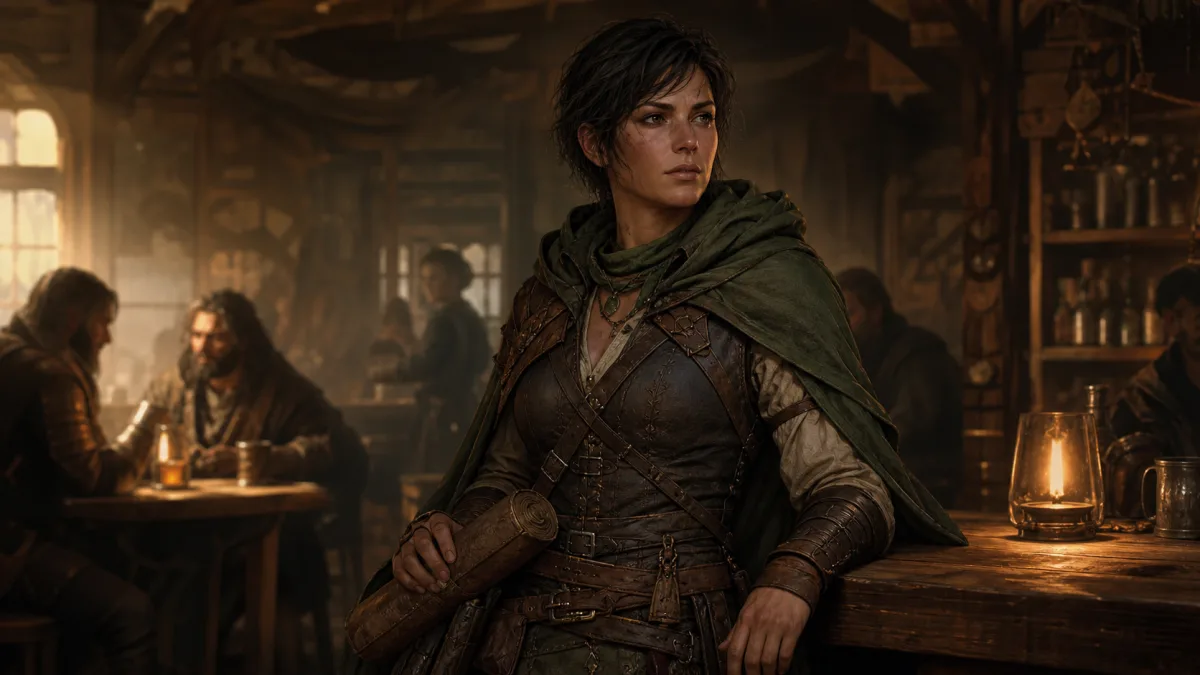
Effective AI RPG character portrait prompts describe a playable identity rather than assembling a pile of fantasy adjectives. Start with the character's role, ancestry or human background, age range, build, and one defining visual trait. Add equipment that supports the role, an expression connected to the current story, a clear camera crop, and one lighting setup. The best fantasy character portrait prompts also distinguish permanent identity details from scene-specific changes. That separation makes it easier to create a calm profile, an injured variant, or a ceremonial outfit without losing the same recognizable person.
Begin with the character's job in the story
A portrait becomes more specific when the prompt explains what the character does. "Fantasy warrior" leaves almost every decision open. "Retired border scout who now guides travelers through flooded ruins" suggests practical clothing, weather exposure, alert posture, and restrained equipment.
Write one sentence covering role and lived context. Include only details that should influence appearance. A court archivist may have ink-stained fingers and carefully repaired clothing; a caravan guard may wear sun-faded layers and maintain equipment for long travel. Avoid turning biography into a full plot summary. The image model needs visible evidence, not information that cannot appear in a portrait.
Create a silhouette players can recognize
Choose two or three shape cues that remain legible at token or card size. These can include a high collar, broad hat, asymmetrical shoulder armor, braided hair, a narrow hood, or a distinctive staff head. Keep the outline purposeful and do not assign a unique object to every body area.
Color can support recognition, but use a restrained palette. Name a dominant neutral, one supporting color, and one accent tied to the character. A moss coat, brown leather, and a small amber clasp is easier to repeat than six equally strong colors. If the character will appear across a series, record the silhouette and palette as fixed identity traits.
Describe face, age, and expression separately
Facial identity and emotion are different controls. Define stable features first: face shape, skin tone, eye color, hairline, hairstyle, scars, freckles, or facial hair. Then request the expression for this image. "Square face, close-cropped gray curls, left eyebrow scar" can remain constant while the expression changes from guarded to relieved.
Use expressions that can be seen rather than abstract personality labels. Replace "wise" with "steady eye contact, relaxed brow, faint tired smile." Replace "evil" with the exact tension, gaze, or posture needed for the scene. This avoids exaggerated grimaces and gives the portrait a more playable emotional range.
Make equipment tell the truth about the role
List only the equipment visible in the chosen crop. A head-and-shoulders portrait does not need boots, belt pouches, and a full weapon inventory. State material, condition, and placement for important items: repaired steel gorget, waxed canvas hood, wooden holy symbol on a cord.
Keep weapon handling plausible. If a weapon is not essential to the portrait, place it sheathed or omit it. Too many overlapping straps, charms, buckles, and blades often create visual errors. For a real game setting, check symbols and uniforms against your own setting notes before publishing; do not let generated details silently rewrite faction lore.
Choose a crop and background for the game interface
Use a square or slightly vertical bust portrait for character sheets and dialogue panels. Keep the complete head, hairstyle, and major silhouette cue inside the safe area. Ask for some margin around the face so circular tokens do not cut off important details.
Backgrounds should reinforce location without competing with the character. A softly blurred watchtower interior, candlelit archive, misty forest edge, or market awning can be enough. Name one light source and its direction. A cool window key with warm fire fill creates readable separation; five magical light colors create confusion.
Browse the AI image showcases to compare portrait crops and lighting moods before building a full party.
Copy-ready RPG portrait prompt
Create a bust-length RPG character portrait of [name or role], a [age range]
[ancestry or human background] [class, trade, or story role]. Stable identity:
[face shape], [skin tone], [eye detail], [hair style and color], and [one scar,
freckle pattern, or other defining feature]. Their recognizable silhouette uses
[two shape cues], with a restrained palette of [dominant], [supporting], and
[accent]. They wear [practical clothing or armor with material and condition]
and carry only [one visible role-relevant item]. Expression: [observable gaze,
brow, mouth, and posture]. Compose for a [square / 4:5] character card, complete
head and shoulders visible, useful margin around the silhouette. Background:
[one subdued setting cue]. Lighting: [single key light] from [direction], with
gentle fill and believable shadows. [Painterly / illustrated / realistic]
rendering with consistent facial anatomy and coherent equipment. No text,
logos, extra weapons, floating accessories, modern objects, or watermark.
Adapt the bracketed details in the AI image generator, then save the identity description before making variants in Create.
Fix common character portrait failures
If different heroes receive the same face, vary facial geometry, age, build, posture, and silhouette before changing surface style. If equipment melts together, remove nonessential accessories and describe one visible item at a time. When a character changes between variants, repeat the fixed identity sentence at the start and change only the expression, setting, or approved costume detail. Correct anatomy and lore conflicts before adding atmosphere.
Build party cohesion without cloning everyone
A party can share rendering style, crop, camera height, background softness, and light direction while each member keeps a different silhouette and accent color. Reuse those production rules, not the same face or costume. Vary age, build, posture, facial geometry, and clothing construction deliberately.
For NPC groups, create a small visual rule for each faction: material family, emblem placement, repair level, and palette. Do not make every member identical. Rank or occupation can change the garment cut and equipment while the faction cue remains consistent.
Review the portrait before using it
- The role is understandable without reading the character sheet.
- Stable facial traits and silhouette cues are clear at small size.
- Clothing and equipment fit the setting and visible crop.
- Hands, ears, jewelry, straps, and weapon parts are coherent.
- The expression is specific without becoming a caricature.
- The background remains subordinate to the face.
- Important features survive square and circular interface crops.
- No invented text, emblem, or lore detail conflicts with the game.
Start with one neutral portrait as the identity anchor. Once the face, silhouette, palette, and rendering style are approved, change only one story variable at a time. That approach produces AI RPG character portrait prompts that support a coherent campaign rather than a folder of unrelated fantasy faces.