AI Album Cover Prompt Examples for Original Visual Concepts
Turn a record's sound and story into original album artwork with clear visual metaphors, square composition, adaptable typography space, and clean exports.
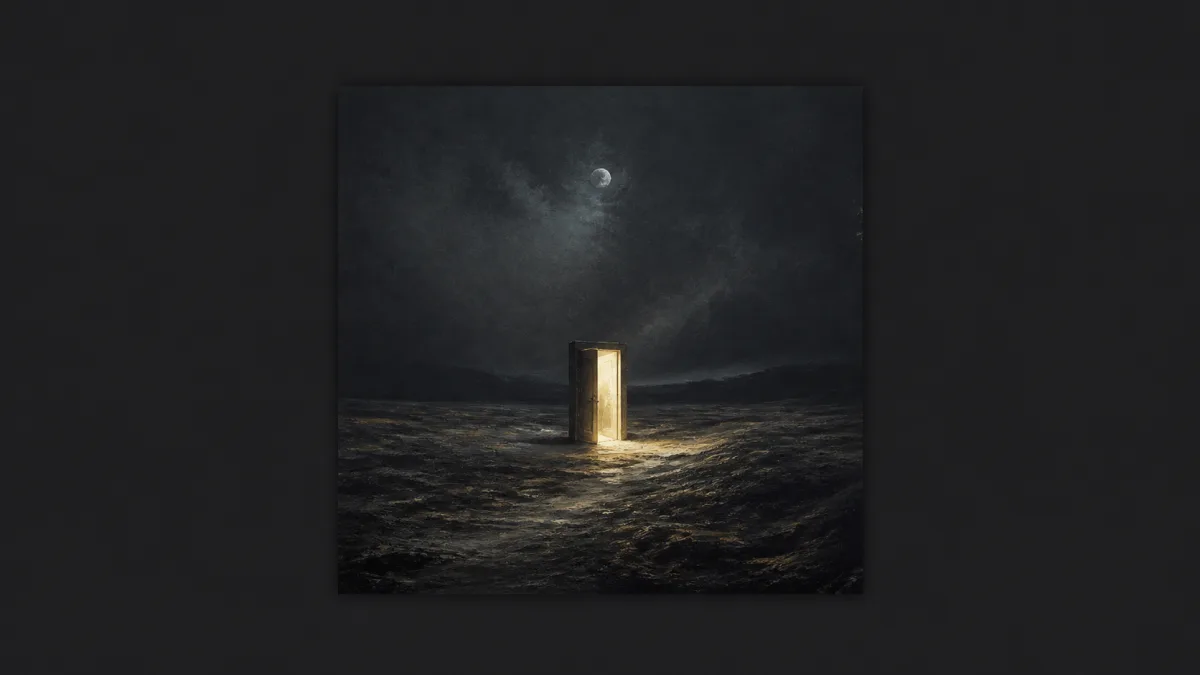
Useful AI album cover prompt examples begin with the record's emotional arc, not a genre stereotype. Select one lyric-free visual idea, such as an object, place, character, or transformation that represents the music. Then define a square composition, medium, palette, texture, light, and space for typography that will be added later. Keep the artwork original: describe visual attributes instead of requesting a named artist's style or recreating an existing cover. A cover should remain recognizable at thumbnail size while revealing more detail when enlarged. Review every generated face, hand, object, and symbol, then add exact album and artist names in a separate design file.
Extract visual language from the record
Listen for repeated contrasts: intimate and expansive, mechanical and organic, restless and calm, dry and luminous. Write down concrete nouns connected to the songs, production, place, or narrative. A cold synthesizer pulse and lyrics about late trains might suggest fluorescent reflections on an empty platform. That is more distinctive than "futuristic electronic album cover."
Choose one emotional tension and one physical setting. The image does not need to explain every track. It needs to open the same imaginative door as the music.
Choose a concept, not a genre costume
Genre can guide pacing and materials, but common shortcuts make covers interchangeable. Avoid adding neon city streets to every electronic release, smoke to every heavy record, or flowers to every acoustic project unless the symbol belongs to this record.
Consider these album artwork prompt ideas:
- A familiar object altered by one impossible physical rule
- A quiet landscape containing a single narrative clue
- A tactile still life assembled from materials heard or mentioned in the record
- A restrained portrait where environment carries more meaning than expression
- An abstract system based on rhythm, repetition, interruption, or decay
Write why the concept belongs to the music before generating it. If the explanation could fit any artist, make the source material more specific.
Set the square composition and type zone
Place the main silhouette far enough from the edges to survive directory crops and small previews. Decide whether typography will sit at the top, bottom, center, or outside the main shape. Ask for a low-detail tonal field in that area rather than a hard blank strip.
Generate without letters. Even when a title is short, add it later with accurate spacing, type, and credits. Keep an artwork-only master so the cover can support clean promotional variants.
Adapt a prompt to the musical direction
Here are four starting concepts rather than finished formulas:
- Intimate folk: a worn kitchen table at dawn, one repaired ceramic cup, soft window light, linen and wood textures, generous quiet space.
- Experimental electronic: translucent geometric sheets interrupted by one rough black seam, cool mineral palette, precise shadows, minimal depth.
- Nocturnal jazz: an empty corner booth after closing, amber practical light, deep blue window reflection, restrained photographic grain, no performers.
- Energetic indie pop: playful dimensional objects balancing in an improbable stack, bright controlled palette, crisp side light, clean square silhouette.
Replace every generic object with something grounded in the record's own world.
Copy-ready original album cover prompt
Create original, text-free square album artwork for a record with this emotional
arc: [brief arc]. The music combines [sonic quality] with themes of [theme or
place]. Express that tension through one visual concept: [specific subject,
transformation, or scene]. Render it as [photography / painting / collage /
dimensional graphic] using [palette], [material or texture], and [light]. Keep
one strong silhouette readable at a small size and reserve a calm [top / bottom]
area for typography added later. Use generous edge margins and intentional
negative space. No words, letters, logos, watermarks, copied album layouts,
celebrity likenesses, copyrighted characters, or imitation of a named artist.
Explore original treatments in Showcases, shape the central idea with the AI image generator, and refine the chosen direction in Create.
Create cohesion for singles and editions
If singles lead into the album, define a visual grammar rather than repeating the same image. Preserve the medium, palette family, margin system, light direction, and type grid. Change one central object or transformation for each release.
Plan deluxe, vinyl, cassette, and streaming uses only when they are part of the release. Physical packaging may need front, back, spine, label, bleed, and legal areas supplied through a manufacturer template. Confirm current specifications with the distributor or printer instead of assuming one universal format.
Fix common cover-art failures
If the result looks generic, remove the genre label and add two details drawn from the actual record. If it resembles another release, change the composition and metaphor rather than applying a different color filter. If the artwork becomes a movie poster, reduce secondary scenes and restore one dominant shape.
When the type zone is unusable, name its position and prohibit high-contrast detail there. If small details vanish, combine them into a larger symbolic form. Remove generated lettering, malformed instruments, inaccurate cultural symbols, and unlicensed marks before considering the cover complete.
Album cover delivery checklist
- The concept has a clear connection to this record's themes or sound.
- One focal shape remains recognizable in a compact player view.
- Typography space is calm and the exact wording is added separately.
- Artwork does not copy a known cover or imitate a named artist.
- Symbols and cultural references are accurate and used with context.
- Faces, hands, objects, edges, and textures pass full-resolution review.
- Artwork-only, editable layout, and final exports are clearly organized.
- Streaming and physical-production requirements are confirmed before delivery.
Choose one lyric, location, texture, or contrast that belongs only to this release. Turn it into a single visual concept, build the text-free square in Create, and test the artwork beside the real title at both thumbnail and packaging scale.
Related guides
Browse all ai creative assets guidesHow to Write an AI Podcast Cover Art Prompt
Create podcast cover concepts with a recognizable visual premise, strong square composition, flexible type space, accurate branding, and clean exports.
How to Write an AI Image Prompt for a YouTube Thumbnail
Build YouTube thumbnail prompts around one clear story, a bold subject, clean contrast, crop-safe composition, and space for accurate added typography.
How to Write a 16:9 AI Image Prompt for a Website Hero
Create wide website hero images with intentional negative space, crop-safe subjects, readable contrast, responsive flexibility, and clear brand direction.
Last updated .